

This blog looks at SWOT analysis marketing the way it actually shows up in real work, not the tidy version that lives in slides and templates. It explains why SWOT still matters when channels shift, results feel mixed, and decisions get messy. Instead of listing traits for the sake of it, the focus stays on position, context, and trade-offs. Where the brand truly has leverage. Where things quietly drag performance down. What’s changing outside that deserves attention now, not later. The guide walks through the framework, common mistakes, and realistic examples, then connects everything back to action. Not a big theory. Just clearer thinking, better priorities, and fewer avoidable missteps over time.
Table of Contents
Introduction
SWOT analysis in marketing usually shows up early in presentations and strategy docs. Four boxes. Neatly labeled. Everyone nods. Then it’s rarely looked at again. That’s the problem. In real marketing work, SWOT isn’t meant to be neat. It’s meant to be useful.
At its best, a marketing SWOT helps make sense of mixed signals. A campaign performs well but only on one channel. Traffic grows, conversions don’t. A competitor with less visibility suddenly wins mindshare. These situations don’t get solved by tactics alone. They need context. SWOT provides that context by forcing marketers to step back and look at the full picture instead of isolated metrics.
In marketing, SWOT isn’t about listing nice-sounding traits. It’s about understanding position. Where the brand stands right now. What it’s genuinely good at. Where it’s exposed. What’s changing around it? Strengths and weaknesses live inside the business: messaging clarity, channel performance, and brand trust. Opportunities and threats live outside: market shifts, competitor moves, and changing audience behavior.
This is why SWOT still matters, even after years of new frameworks and growth models. It slows decision-making just enough to prevent costly mistakes. It pushes teams to ask better questions before committing budget or doubling down on a strategy that feels familiar but no longer fits.
When used properly, SWOT becomes less of a planning exercise and more of a thinking habit. Something that informs choices, not just documents them.
SWOT Analysis Explained: Strengths, Weaknesses, Opportunities & Threats
SWOT looks simple on paper. That’s intentional. Marketing is already noisy; dashboards, reports, opinions flying around. SWOT cuts through that noise by narrowing focus to four essential areas. No more. No less.
What Is SWOT? A Quick Overview
SWOT stands for strengths, weaknesses, opportunities, and threats. In marketing, these aren’t abstract labels. They represent patterns that show up again and again in performance, feedback, and outcomes. The framework helps organize those patterns so decisions don’t rely entirely on instinct or momentum.
One thing that often gets missed: marketing SWOT is not the same as general business SWOT. This isn’t about supply chains or internal processes. It’s about how a brand competes for attention, trust, and action. Visibility. Relevance. Consistency. These are the levers marketing actually controls.
The four-part structure matters because it separates what can be influenced from what can’t. Strengths and weaknesses come from inside the brand. They change slowly and require deliberate effort. Opportunities and threats come from the outside. They change fast and don’t wait for internal alignment. Seeing both together makes it easier to judge what’s realistic and what’s risky.
Internal Factors: Strengths & Weaknesses in Marketing
Marketing strengths aren’t aspirational statements. They’re things that work even when conditions aren’t perfect. A message that lands without heavy explanation. A channel that performs steadily, not just during peak campaigns. An audience that trusts the brand enough to come back.
Weaknesses are usually quieter. They show up as friction. Campaigns that need constant tweaking. Channels that consume time but never quite deliver. Messaging that sounds right internally but doesn’t resonate externally. These areas don’t always feel urgent, which is why they linger.
What matters most here is honesty. A strength only matters if it creates real leverage in the current market. A weakness only matters if it limits growth, efficiency, or consistency. Looking at internal factors without comparison to competitors, to audience expectations, misses the point of the exercise.
External Factors: Opportunities & Threats in Marketing
External factors are where marketing strategies often succeed or fail. Opportunities appear when something shifts: how audiences behave, where attention moves, what competitors overlook. These moments don’t announce themselves loudly. They’re easy to miss if focus stays inward.
Threats tend to arrive slowly. Rising costs. Declining reach. Increased competition. Platform changes that quietly reshape performance. None of these feels dramatic on their own, but together they can undermine even strong marketing foundations.
Understanding opportunities and threats isn’t about prediction. It’s about awareness. Marketing teams that regularly scan the external landscape adapt faster. Those who don’t often find themselves reacting late, wondering when things changed.
Why SWOT Analysis Matters for Marketing Strategy
Most marketing strategies struggle not because they lack creativity, but because they’re disconnected from reality. SWOT analysis helps bridge that gap.
It brings structure to decisions that are otherwise driven by habit or urgency. It helps clarify where effort will compound and where it will stall. A genuine strength paired with a real opportunity usually signals focus. A visible weakness combined with a growing threat signals risk that shouldn’t be ignored.
SWOT also makes competitive positioning clearer. Instead of chasing what others are doing, it highlights what actually sets the brand apart. That difference, when used intentionally, tends to outperform trends over time.
When tied directly to marketing goals, SWOT becomes practical. Budgets make more sense. Campaign priorities sharpen. Channel decisions feel intentional rather than reactive. It doesn’t guarantee success, but it reduces avoidable mistakes.
Marketing moves fast. SWOT doesn’t slow it down unnecessarily. It slows it just enough to think before acting. And that pause often makes all the difference.
SWOT Analysis for Marketing: Step-by-Step Guide
A marketing SWOT works best when it’s treated like a thinking process, not a worksheet. The goal isn’t to fill space. It’s to surface patterns, tensions, and trade-offs that aren’t obvious when everything is looked at separately. Rushing this part usually leads to vague insights. Taking time here pays off later.
How to Start Your Marketing SWOT Analysis
Before anything goes into a quadrant, the purpose needs to be clear. A SWOT done for “marketing in general” tends to drift. A SWOT analysis done for a specific goal, brand growth, lead generation, market entry, and repositioning, stays grounded. That objective becomes the filter for what matters and what doesn’t.
Clarity also depends on who’s involved. Marketing doesn’t operate in isolation, and neither should the analysis. Input from people close to execution, performance, and customer feedback adds texture. Different perspectives often surface blind spots that don’t show up in reports. Alignment matters, but tension is useful too. It usually means something real is being discussed.
At this stage, it helps to resist solutions. This is about observation first. Patterns over opinions.
Detailed SWOT Breakdown
This is where the real work happens. Each quadrant deserves attention, but not equal weight. Some will naturally carry more insight depending on the situation.
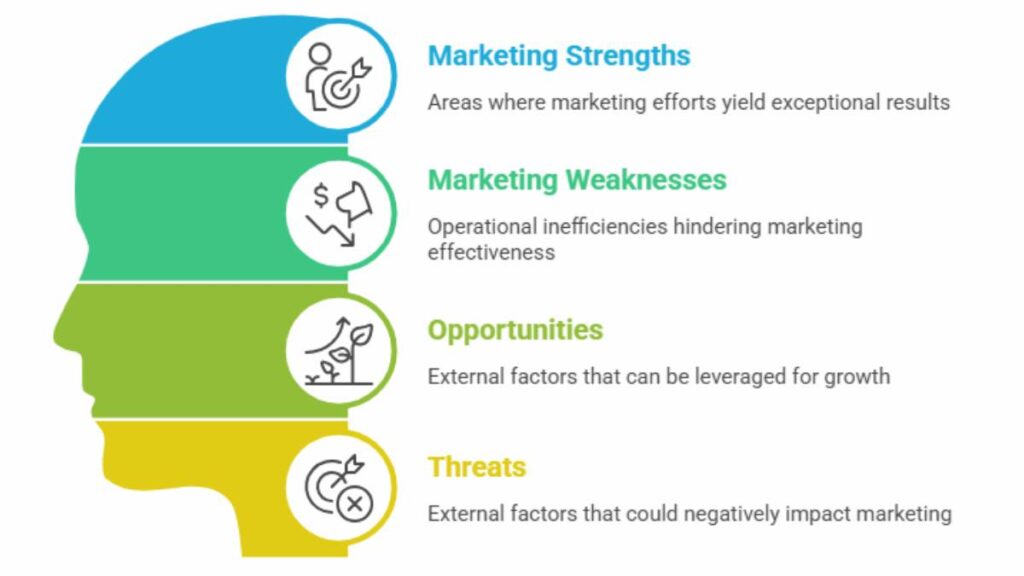
Marketing strengths are easiest to overstate, so precision helps. Look for evidence. Consistent performance across time. Clear signals from customers. Market recognition that doesn’t rely on heavy promotion. Strengths often show up where effort produces outsized results.
Marketing weaknesses require a bit more discipline. These are not areas that feel uncomfortable emotionally; they’re areas that create drag operationally. Poor engagement despite high reach. Channels that demand constant fixes. Messaging that requires explanation. Weaknesses become clearer when performance data is paired with honest discussion.
Opportunities come from paying attention outward. Shifts in customer behavior. Emerging content formats. Competitors are narrowing their focus and leaving gaps. Opportunities aren’t guaranteed wins, but they’re directions worth testing, especially when they align with existing strengths.
Threats tend to be underestimated. Competitive pressure, rising costs, changing platforms, shifting expectations. These don’t always arrive as sharp drops. Often, they show up as slow erosion. Identifying threats early creates options. Ignoring them removes choice.
The most useful SWOTs avoid laundry lists. Fewer, sharper points create more direction than long, unfocused ones.
Using Data & Tools for Marketing SWOT Analysis
Data doesn’t replace judgment, but it keeps the analysis honest. Performance trends, audience behavior, conversion patterns, and feedback all provide grounding. Numbers don’t tell the whole story, but they do challenge assumptions.
Structure also matters. Simple frameworks help organize thinking without overcomplicating it. A clean four-quadrant layout keeps discussion focused. What’s written should be specific enough to act on, but flexible enough to revisit as conditions change.
The goal isn’t to lock the analysis in place. It’s to create a reference point that evolves.
Common Mistakes in Marketing SWOT Analysis
The most common mistake is vagueness. Words like “strong,” “weak,” or “competitive” without context don’t help anyone make decisions. If a point can’t be explained or defended, it probably doesn’t belong.
Another issue is excess. Too many factors dilute focus. When everything is a priority, nothing is. A good SWOT analysis feels selective. It highlights what truly shapes outcomes, not everything that could be mentioned.
Finally, treating SWOT as a one-time task limits its value. Markets change. Teams change. Performance changes. A SWOT that’s revisited and refined stays relevant. One that’s filed away becomes outdated quickly.
Done properly, this step turns observation into insight. And insight is what strategy is built on.
SWOT Examples for Marketing Professionals
Examples are where SWOT stops feeling abstract and starts making sense. Not polished case studies. Realistic situations marketers actually deal with.
A digital retail brand might discover that its biggest strength isn’t product range, but repeat customers who trust the brand enough to buy without heavy discounts. At the same time, weak organic visibility keeps acquisition costs high. Opportunities may come from shifting consumer interest toward niche products, while threats show up in the form of aggressive pricing from larger marketplaces. The insight here isn’t “do more marketing.” It’s to lean into loyalty while fixing discoverability slowly and intentionally.
For a SaaS marketing campaign, strengths often live in clarity. Clear messaging, strong demos, and high trial-to-paid conversion rates. Weaknesses tend to show up earlier in the funnel; low awareness or limited reach in new segments. Opportunities might exist in underserved industries or changing work patterns. Threats usually come from feature parity as competitors catch up. This kind of SWOT highlights where education and positioning matter more than volume.
A local small business sees SWOT differently. Strength might be reputation and word-of-mouth. Weakness could be inconsistent visibility beyond the immediate area. Opportunities often exist in local partnerships or community-driven content. Threats are usually larger brands moving into the same space. Here, the takeaway is focus. Trying to outspend competitors rarely works. Out-connecting them often does.
Good examples don’t aim to impress. They aim to clarify.

Apply Now: AI-Powered Performance Marketing Course
How to Turn Your SWOT Analysis Into an Actionable Marketing Strategy
A SWOT analysis only becomes valuable when it leads to decisions. Otherwise, it’s just a reflection without movement.
Start by prioritizing. Not every insight deserves equal attention. The strongest signals usually sit where strengths and opportunities overlap. That’s where effort tends to compound. Weaknesses paired with real threats need attention too, but often in the form of risk management rather than aggressive growth.
Action comes from translation. Each key insight should connect to a marketing decision:
- Which channels deserve more focus?
- Which messages need refining?
- What experiments are worth running, and which aren’t?
SWOT also helps avoid scattered execution. When insights are clear, it becomes easier to say no. No to campaigns that don’t align. No to channels that dilute focus. That restraint often improves results more than adding new tactics.
Finally, strategy doesn’t end once actions are defined. Performance should be tracked against the assumptions made in the SWOT. When results change, the analysis should change too. That loop: insight, action, review, is where consistency comes from.
SWOT Templates & Tools for Marketing Teams
Structure helps, but only if it doesn’t get in the way. In practice, the SWOT templates that last are the simple ones. A basic four-quadrant grid in Google Docs, Notion, or even a shared slide deck often works better than fancy software. Everyone knows where to add input, and no one needs training to use it.
For teams that want a bit more depth, Notion templates are a common choice. Each quadrant can expand into notes, links to data, or past decisions, which makes it easier to see how thinking has changed over time. Miro and FigJam work well when SWOT is done live. Sticky notes, quick edits, a bit of debate. Messy, but productive.
Spreadsheets still have a place, too. A simple Google Sheet with columns for evidence, impact, and follow-up actions helps turn observations into decisions.
The best tool isn’t the most advanced one. It’s the one the team will actually open again next quarter.
Conclusion:
SWOT analysis sticks around in marketing because it does one thing well: it cuts through assumptions. Not perfectly. Not cleanly. But enough to get everyone looking at the same reality instead of separate dashboards and opinions.
When used with intent, SWOT helps marketing teams slow down just a bit. Long enough to notice patterns. Long enough to question habits. Long enough to stop repeating tactics that feel productive but don’t move the needle. Strengths become clearer when they’re named honestly. Weaknesses lose some of their sting once they’re acknowledged. Opportunities stop feeling random. Threats feel manageable, or at least visible.
The mistake is treating SWOT like a document that gets finished. It’s not. It works best as a reference point. Something to come back to when results dip, when priorities shift, or when a new idea sounds exciting but doesn’t quite fit.
Marketing is rarely short on ideas. It’s clarity that’s harder to find. SWOT doesn’t solve everything, but it does make the path forward easier to see.
FAQs:
What is an example of a marketing SWOT analysis?
A realistic marketing SWOT might look like this: strong repeat customers and brand trust on one side, weak visibility outside existing audiences on the other. Opportunities could come from changing buyer behavior or unmet needs, while threats might show up as new competitors or rising costs. The value isn’t in the list itself; it’s in what those points force the team to prioritize next.
How often should you update your marketing SWOT?
Whenever the ground shifts. That could be once a year, or sooner if performance changes, a new market opens up, or strategy pivots. A SWOT that hasn’t been revisited in years usually reflects a past version of the business, not the current one.
Can a SWOT analysis improve digital marketing performance?
It can, but only if it leads to decisions. SWOT helps highlight which channels deserve more attention, which messages need tightening, and where effort is being spread too thin. That focus alone often improves results, even without changing much else.
Should SWOT be part of every marketing plan?
Not as a checkbox. As a starting point. Marketing plans built without this kind of reflection tend to rely on momentum and assumptions. SWOT brings those assumptions into the open, which usually leads to better choices and fewer surprises later.