
Table of Contents
Introduction – The New Age of the Agentic Web
The web is evolving. Lately, we’re seeing the transition from human-centric browsing to an agentic web where AI agents don’t just fetch information but take actions on a user’s behalf – like booking flights, filling forms, and automating complex workflows. At the heart of this shift sits WebMCP (Web Model Context Protocol), a new, browser-based standard designed to let websites expose structured tools directly to AI agents.
Google made WebMCP available in early preview via Chrome 146 Canary behind an experimental flag, signaling the web’s future direction.
What is WebMCP?
In its essence, WebMCP (Web Model Context Protocol) is a standard specification and browser API that allows a web application to:
- Publish structured, callable tools and actions on a page,
- Tell ai agents exactly what actions are available and how to perform them,
- Enable agents to execute tasks reliably without guessing UI element positions or scraping raw DOM.
Without WebMCP, AI agents had to interact with web pages the same way a human does – by visually clicking buttons, interpreting layout, and reverse-engineering UI flows. This approach is fragile, slow, and inefficient for automated interactions.
With WebMCP, a web application becomes its own MCP server in the browser’s context – meaning the site itself publishes its own structured tools directly to the agent.
In technical terms, WebMCP introduces a new Navigator API (navigator.modelContext) where sites can register tools such as searchProducts, bookFlight, or submitSupportTicket, along with input and output schemas that agents can consume.
WebMCP Works via Two Integration Paths
Google’s WebMCP specification defines two main APIs that websites can implement:
1. Declarative API
This approach lets developers expose standard interactions directly through HTML – by annotating form elements with structured metadata telling an agent what the action is, what parameters it needs, and how to execute it.
Example uses:
- Sign-up forms
- Search queries
- Simple click-to-submit actions
2. Imperative API
For more dynamic workflows – like e-commerce carts, custom search filters, or multi-step user flows – WebMCP uses JavaScript registration methods (like registerTool) so agents can execute complex functions with structured inputs and outputs.
This makes the web application capable of serving as a rich set of agent-callable tools, not just a collection of visual UI elements.
Why WebMCP Matters for Web Developers and Enterprises
WebMCP introduces a paradigm shift in development by:
1. Eliminating Fragile Automation
Previously, AI agents had to rely on brittle UI automation – clicking buttons and scraping content. WebMCP gives them a reliable, structured toolset directly from the page.
2. No Separate MCP Servers Needed
Unlike traditional Model Context Protocol implementations, where a backend MCP server was required, WebMCP runs in-browser – effectively turning the client-side code into the MCP implementation.
Your website logic becomes the agentic interface.
3. Collaborative Workflows
WebMCP enables hybrid interactions where human users and AI agents work together seamlessly within the same UI context. This means agents can suggest actions but still prompt human confirmation when needed, enabling safer automation.
Why WebMCP Matters for SEOs and Marketers
This is where WebMCP becomes transformative:
The Rise of Agentic SEO
Traditional SEO has focused on human readability and search engine ranking signals, but with agents executing actions, SEO must evolve into Agentic SEO – optimizing sites for autonomous agents, not just human crawlers.
In this model:
- Your site must expose actionable tools – not just text content – so agents can perform tasks reliably.
- If an AI agent can’t discover or call important tools (like purchase, search, booking, checkout), your site may effectively become invisible to agent-driven users.
Google’s WebMCP essentially creates a new visibility layer – structured and executable – that SEO professionals must now optimize.
Continuous WebMCP Auditing
Like Core Web Vitals or structured data, WebMCP integrations will need ongoing auditing. Whenever a form or dynamic feature is updated, SEOs must ensure WebMCP-registered tools remain accurate and complete so that agents don’t fail.
This could become a new class of ranking and experience signals.
What You Can Use WebMCP For (Key Use Cases)
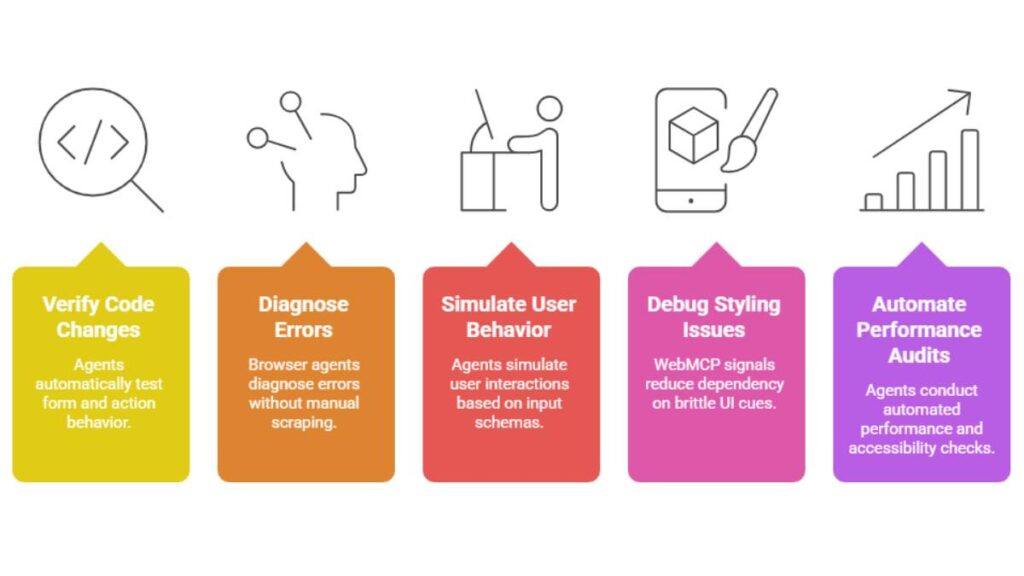
Here are some of the most exciting applications:
Verify Code Changes in Real Time
Agents can automatically test whether your forms and actions still behave as expected.
Diagnose Errors Without Manual Scraping
Browser agents won’t have to guess button assignments or infer DOM clues – your tool signatures are explicit and structured.
Simulate User Behavior
Agents can simulate interactions like filling out a complex multi-step form based on defined input schemas.
Debug Live Styling & Layout Issues
WebMCP signals reduce dependency on brittle UI cues – so design updates don’t break agent workflows.
Automate Performance Audits
Agents can conduct automated performance and accessibility checks that are structured, not heuristic.
And as WebMCP becomes more widely implemented:
- Customer support workflows can be fully automated via agentic tools.
- E-commerce checkout and filter actions can be executed automatically.
- Travel booking flows can be agent-performed without a human clicking through pages.
What is Agentic SEO and Why Does It Matter?
Agentic SEO is the practice of optimizing a website so that autonomous ai agents can discover, understand, and execute actions on that site – not just read text or extract content. In an agentic web:
- AI assistants like ChatGPT, Claude, or Gemini become primary traffic channels.
- They fetch answers and execute tasks (search, booking, checkout) on users’ behalf.
- Websites that don’t implement standards like WebMCP risk being bypassed or misinterpreted by these agents.
This requires:
- Structured WebMCP tool contracts
- Accurate JSON schemas describing inputs/outputs
- Continuous auditing of WebMCP integrations
- Collaboration between developers and SEO professionals to ensure tools match expectations
In other words, SEO becomes action-centric, not just discovery-centric.

Enroll Now: AI Marketing Course
Looking Ahead – The Future of Web and AI
Google is expected to continue formalizing WebMCP throughout 2026. As this protocol matures, it’s likely that browser vendors, AI platforms, and CMS ecosystems will adopt WebMCP or similar standards as a baseline requirement for agentic interaction.
Optimizing for WebMCP today is quite similar to optimizing for mobile search in the early 2010s – early adopters stand to dominate how AI agents choose and execute actions on the web tomorrow.
Conclusion
WebMCP isn’t just a developer trick. It represents:
- A new web standard for agent-friendly automation.
- A fundamental shift in how web content and actions are surfaced to machines.
- A core requirement for future SEO and automation workflows.
Whether you’re a seasoned developer, an SEO professional, or a digital strategist, understanding WebMCP – and preparing for an agentic web – will be one of the most pivotal skills in 2026 and beyond.
Google WebMCP FAQs
What is WebMCP by Google?
WebMCP (Web Model Context Protocol) is a proposed browser API introduced by Google that enables websites to expose structured, callable tools directly to AI agents. It allows client-side registration of tools with defined input and output schemas, reducing reliance on DOM scraping and UI-based automation.
Is WebMCP part of the Model Context Protocol (MCP)?
Yes. WebMCP adapts the broader Model Context Protocol (MCP) standard for use within web browsers. It enables web applications to act as MCP-compatible tool providers (like Claude), allowing AI agents to discover and invoke tools directly via the browser environment.
How does WebMCP work technically?
WebMCP allows websites to register structured tools using browser APIs such as navigator.modelContext. Each tool includes a name, natural language description, and JSON schema defining expected inputs and outputs. AI agents can invoke these tools using a JSON-RPC–based communication pattern within the browser.
How is WebMCP different from a traditional API?
Traditional APIs require server-side endpoints and explicit integration between systems. WebMCP enables tool registration directly within the client-side web application, making the website itself callable by AI agents without requiring a separate MCP server.
Does WebMCP replace structured data or schema markup?
No. WebMCP does not replace structured data such as Schema.org markup. Structured data helps search engines understand content, while WebMCP enables AI agents to perform actions. They serve complementary roles within search and agent ecosystems.
What is Agentic SEO?
Agentic SEO is the practice of optimizing a website so AI agents can discover, understand, and execute actions on it. It involves exposing structured tools, maintaining accurate schemas, and ensuring workflows remain functional for automated agent interactions.
Why should digital marketers care about WebMCP?
As AI agents increasingly perform research, bookings, purchases, and support interactions, websites that expose structured tools via WebMCP may become more accessible to AI-driven traffic. Digital marketers should ensure critical actions such as form submissions, product searches, and checkout flows are agent-ready.
How does WebMCP impact e-commerce SEO?
WebMCP allows e-commerce sites to expose structured tools for searching products, filtering results, updating carts, and completing purchases. If these workflows are not properly registered and maintained, AI agents may be unable to complete transactions, affecting visibility in agent-driven experiences.
Do informational blogs need WebMCP?
Purely informational websites may not require complex tool exposure. However, any site that relies on forms, interactive workflows, customer support portals, bookings, or transactions may benefit from implementing WebMCP to remain compatible with AI agents.
How do AI agents discover WebMCP tools?
AI agents detect registered tools through the browser’s WebMCP interface when visiting a page. Tools are exposed contextually, meaning agents only see the tools available for the specific page or component currently loaded.
Will WebMCP change how marketers measure traffic?
Potentially. As AI agents begin executing actions on behalf of users, traditional analytics may need to differentiate between human-driven interactions and AI agent workflows. This could introduce new tracking and attribution models in 2026 and beyond.