
Content briefs; sounds simple, right? But in practice, they’re where most content either takes off or crashes. This blog goes through what is a content brief and why it matters, without overcomplicating things. It’s about getting everyone on the same page early: who the reader is, what they need, what the piece should cover, and how it should flow. Along the way, it points out common slip-ups; briefs that are too vague, too rigid, or just plain ignored; and shows how to make one that’s actually useful. By the end, it’s less theory, more practical steps that help content land, not just exist.
Table of Contents
Introduction
Content can look busy on the surface. Calendars full, drafts moving, posts going live every week. Yet behind the scenes, things often feel… messy. Articles miss the mark. Messaging feels inconsistent. Writers and stakeholders keep circling back with “This isn’t quite what we meant.” Sound familiar to a lot of teams.
The issue usually isn’t talent. Its direction, or more accurately, the lack of a clear, shared direction before the writing starts.
That’s the gap a content brief is meant to fill.
A content brief gives shape to an idea before it turns into 1,500 words that may or may not hit the goal. It pulls expectations out of scattered notes, quick calls, and half-formed thoughts, and puts them into one working document. Not fancy. Not theoretical. Just practical guidance everyone can point to.
It’s also worth saying what a content brief isn’t. It’s not a rigid script that dictates every paragraph. And it’s definitely not a one-line instruction like “Write about this topic and make it engaging.” That’s not a brief; that’s a gamble.
When content is tied to real business goals, brand positioning, or customer education, guessing is expensive. A content brief reduces that guesswork. It gives the writer clarity, the editor confidence, and the team a shared understanding of what success looks like for that piece of content.
What Is a Content Brief?
Content Brief Meaning Explained
A content brief is a structured document that outlines the purpose, audience, scope, and key requirements for a specific piece of content before it’s written.
Simple idea. Big impact.
It translates strategy into execution. A strategy might say, “We need to educate potential customers about this topic.” The brief turns that into something usable: who those people are, what they’re trying to understand, which points matter most, and how the content should be organized to make sense.
Most strong content briefs clarify things like:
- Who the target audience is, not just a broad label, but what they likely care about or struggle with
- What is the main goal of the piece is; inform, compare, persuade, explain, or guide
- Which key topics must be covered so the content feels complete, not surface-level
- How the content should be structured, at least at a high level
- What the reader should walk away with: a clearer understanding, a decision, a next step
Notice what’s missing: exact sentences, rigid scripts, or forced phrasing. A brief doesn’t do the writing. It sets the direction so the writing has a clear destination.
Without a brief, writers are left filling in blanks on their own. Sometimes that works out. Other times, the draft comes back technically solid but strategically off. Wrong emphasis. Wrong depth. Wrong angle. All because the starting point was fuzzy.
A content brief removes that fuzziness.
Why Content Briefs Matter in Digital Content Creation
Digital content usually involves more than one brain. Marketing wants alignment with positioning. Product teams want accuracy. Sales wants relevance. Leadership wants results. Writers are expected to somehow balance all of that, often with partial information.
That’s where things break.
Without a content brief, each person carries a slightly different picture of what the piece is supposed to do. Those differences don’t show up in the planning stage. They show up later, during review, when feedback sounds like:
- “This isn’t really what we were aiming for.”
- “Can we shift the focus more toward this angle instead?”
- “We should also add a section about…”
At that point, the piece is already built. Now it has to be reshaped.
A good content brief brings those expectations together early, while changes are still cheap and easy. It creates a shared reference point. If questions come up mid-draft, the brief is where everyone looks. Not memory. Not old messages. The actual plan.
There’s also a less obvious benefit: better use of creative energy. When writers don’t have to guess the basics- audience, purpose, scope- they can focus on clarity, flow, and making the content genuinely useful. The mental load shifts from “What am I supposed to do here?” to “How do I explain this in the clearest, most engaging way?”
That’s a big difference.
Over time, teams that use content briefs consistently tend to see fewer major revisions, smoother collaboration, and content that feels more intentional. Not perfect, never perfect, but aligned. And in content work, alignment quietly does a lot of heavy lifting.
How to Write a Content Brief (That Writers Actually Like Using)
A content brief is supposed to make writing easier. Funny thing is, a rushed or vague one does the exact opposite. More edits. More back-and-forth. More “This isn’t quite what we meant.”
A solid brief doesn’t have to be long. It just has to be clear where it counts.
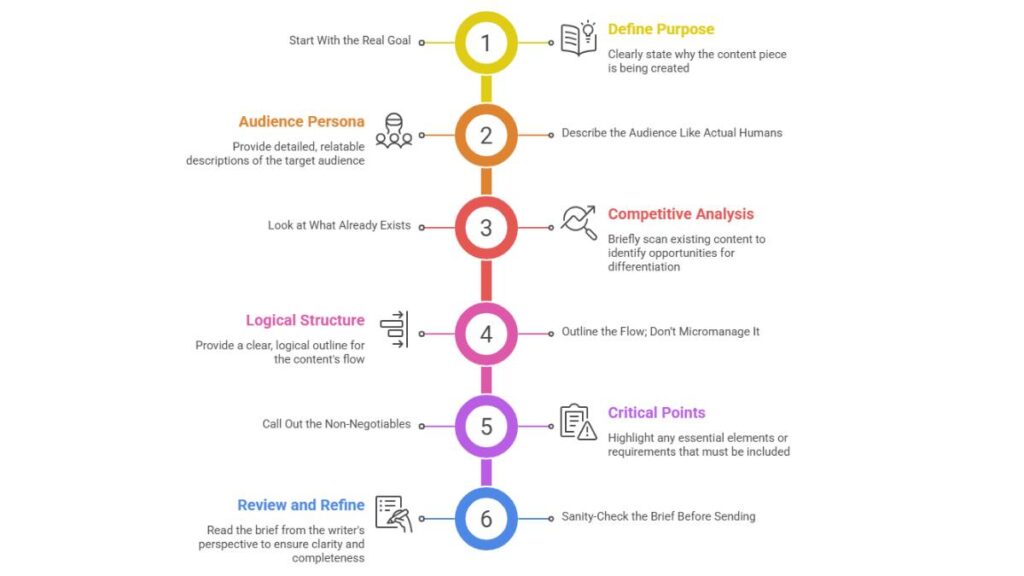
Start With the Real Goal (Not Just the Topic)
“Write a blog about X” isn’t a goal. It’s a placeholder.
The brief should explain why this piece exists in the first place. Is it meant to attract search traffic? Help sales conversations? Educate existing users? Tackle a question that keeps popping up in demos?
When the purpose is fuzzy, the draft usually wanders. When the purpose is clear, decisions about angle, depth, and examples get a lot easier.
Describe the Audience Like Actual Humans
A lot of briefs say things like “targeting marketers” or “small business owners.” That’s… technically true and completely unhelpful.
Better audience notes sound more like this:
- They’ve heard of the topic but don’t fully understand how it works
- They’re comparing options and trying not to make an expensive mistake
- They’ve been burned before and are skeptical
Now the writer knows how much to explain, what tone to use, and where to slow down. Big difference.
Look at What Already Exists (Briefly, But Intentionally)
Before outlining, it helps to scan what’s already ranking or circulating. Not to copy the structure, but to see the pattern.
Usually, you’ll notice:
- The same definitions are repeated everywhere
- Lists that feel padded
- Advice that sounds nice but isn’t very actionable
That’s the opportunity. The brief can call out where this piece should go deeper, be clearer, or give more practical guidance than the usual surface-level stuff.
Outline the Flow; Don’t Micromanage It
Writers don’t need every paragraph pre-written in the brief. They do need a logical path.
Something like:
- Open with a clear explanation of the topic and why it matters
- Break down key parts, steps, or components
- Cover common mistakes or misconceptions
- End with practical takeaways or next steps
This keeps the draft from feeling like a pile of decent but disconnected sections. Flow matters more than people think.
Call Out the Non-Negotiables
Some points are too important to leave to chance. The brief should flag them clearly.
Maybe there’s a specific framework that must be included. A misconception that needs correcting. A feature that should be mentioned in a helpful, non-salesy way.
If it’s critical, write it down. Otherwise, it turns into, “Can we add this?” during revisions. Everyone’s favorite phase. Not.
Sanity-Check the Brief Before Sending
Takes five minutes. Saves hours later.
Read the brief as if seeing it for the first time. Are there phrases that could mean two different things? Is the audience description clear enough to guide tone? Does the outline actually flow?
It doesn’t need to be perfect. Just tight enough that the writer isn’t guessing what success looks like.
What a Simple, Useful Content Brief Includes
Different teams dress it up in different formats, but most good briefs cover the same ground:
- Working title
- Goal of the piece (traffic, education, conversion support, etc.)
- Target audience description (with context, not just a label)
- Reader intent (what they’re trying to figure out)
- Core topic and key subtopics
- Suggested structure or section flow
- Must-cover points
- Internal links or related resources
- Tone notes (if there’s something specific to aim for)
- Rough length range, if that matters
Short is fine. Vague isn’t.
Content Brief vs. Creative Brief (They’re Not Twins)
These get mixed up a lot.
A content brief is about executing one specific asset. It’s practical. Ground-level. It tells the writer what this piece needs to do and include.
A creative brief usually sits higher up. Campaign message. Brand tone. Emotional direction. Big-picture stuff.
Both are useful. Problems start when a writer gets a campaign-level creative brief… and is expected to magically turn that into a tightly structured, SEO-informed article. That gap is where confusion lives.
A good content brief closes that gap. Clear purpose. Clear audience. Clear structure. The rest becomes a lot smoother.
If you want, share the next section you’re working on, and the target audience can reshape it with more real-world texture and sharper practical detail.

Enroll Now: Advanced Digital Marketing Course
Smarter Ways to Build Stronger Content Briefs
Creating a solid brief doesn’t have to mean starting from a blank page every time. A lot of the heavy lifting can be sped up by leaning on structured research and organized workflows. The key is using support systems without letting them replace thinking.
Some practical ways teams make the process faster and sharper:
Use structured research, not guesswork
Pull in real search behavior, common questions, and topic variations people are already exploring. This helps shape the angle and ensures the brief reflects what readers actually want to know, not just what sounds good internally.
Study real-world competition, briefly but intentionally
Looking at top-performing pages reveals patterns: what they all cover, where they stay shallow, and where they overcomplicate things. That gap is where a better piece can stand out. The brief should point that out clearly.
Centralize notes and insights
When audience research, messaging, and topic notes live in one place, briefs get sharper. When they’re scattered across docs and chats… details slip through. A shared, repeatable format keeps everyone aligned.
Build reusable frameworks
After a few strong briefs, patterns emerge. Sections that always matter. Questions that always come up. Turning those into a repeatable structure saves time and raises the floor for quality.
Support systems should speed up clarity, not create noise. If a brief feels bloated or generic, the process probably needs tightening.
Common Mistakes to Avoid When Writing Content Briefs
Even experienced teams fall into a few familiar traps. Most of them come down to being either too vague or too prescriptive.
Focusing on the topic, not the reader
A brief that only explains what to write about, without clarifying who it’s for and what they’re trying to figure out, leaves writers guessing. That usually leads to drafts that feel technically correct but emotionally flat.
Stuffing in keywords without context
Listing a pile of phrases without explaining how they fit into the topic creates awkward writing. The brief should clarify priority, intent behind each term, and where a deeper explanation is needed.
Overloading the outline
There’s a difference between helpful structure and micromanaging. When every subheading is already written like a paragraph, the writer has no room to think. The result often feels stiff and mechanical.
Ignoring competing content
If the brief doesn’t account for what’s already out there, the final piece risks saying the same things in the same way. Readers don’t need another recycled explanation; they need clearer, more useful guidance.
Forgetting the end goal
Sometimes, briefs get so caught up in structure and keywords that they forget why the piece exists. Is the goal to educate? Compare options? Build trust? That purpose should guide the depth, tone, and examples throughout.
A good brief reduces confusion. A bad one just moves the confusion from planning to editing.
How Content Briefs Influence Visibility and Performance
Strong briefs don’t just make writing easier; they shape how well a piece performs once it’s live.
Search platforms have evolved. They now surface content that answers questions clearly, covers topics thoroughly, and follows a logical structure. A thoughtful brief lays that foundation before a single word is drafted.
Here’s where briefs make a real difference:
Clear structure leads to clearer answers
When sections are planned around specific questions and subtopics, the final piece is easier to scan and easier to pull insights from. That increases the chances of being featured in enhanced results and summary views.
Complete topic coverage builds authority
Briefs that map out related angles, supporting points, and common follow-up questions help avoid thin content. Thorough coverage signals that the piece is a reliable resource, not just a surface-level overview.
Alignment improves consistency
When writers, editors, and strategists work from the same direction, the end result feels cohesive. That consistency improves readability, and readers staying longer is always a good sign.
Better intent matching improves engagement
If the brief is grounded in what the audience is actually trying to solve, the finished article is more likely to hold attention, answer the right questions, and encourage further exploration.
In short, the brief quietly shapes everything that follows. Clear thinking at the planning stage turns into a stronger structure, better answers, and content that earns its place in modern search results.
Conclusion
Content briefs… they look simple on paper, but their absence is obvious in every messy draft. When a writer doesn’t know exactly who they’re writing for or what questions they need to answer, the results get sloppy fast. Endless edits. Misaligned messaging. Sections that don’t connect. It’s exhausting, really.
A good brief fixes that. It doesn’t have to be fancy. One or two pages of clear direction: audience, purpose, must-cover points, structure, and suddenly, the writer has something to actually work with. The article comes together easier, the editor has fewer headaches, and the whole thing just… flows better.
Small details matter here. A quick note on tone. Flagging that one tricky point everyone forgets. Even a short reminder of the reader’s biggest confusion. Those little things in a brief save hours down the line.
If briefs feel like a chore, don’t overcomplicate them. Jot the essentials. Sketch a structure. Flag the must-haves. That’s often enough to turn a mediocre draft into something solid. And honestly, once teams get used to it, everyone wonders how they ever did without it.
FAQs: About Content Briefs
1. What’s the difference between a brief and an outline?
An outline is just the skeleton. Headings, subheadings, and the flow of the piece. A brief is the full map: who the reader is, what they’re struggling with, key points to cover, tone, and context. Without a brief, even a perfect outline can leave the writer guessing on the “why” behind each section.
2. How long should a content brief be?
Long enough to answer the obvious questions. Short enough that people will actually read it. Usually, a page or two is fine. If it starts creeping into ten pages… well, that’s usually overkill. Chances are, it’s either overexplaining or including unnecessary fluff.
3. Can a content brief be reused?
Parts of it, yes. Audience notes, tone pointers, maybe even a section framework. But topic-specific points? Those always need updating. Copying a brief wholesale tends to create stale content; it rarely works out the way you hope.
4. What’s the ideal word count for brief sections?
Depends. Some sections just need a line or two, like the goal or headline. Others, like audience notes or key points, need a bit more detail so the writer isn’t guessing. The aim isn’t length. The aim is clarity. If a writer can pick it up and know exactly what to create without asking questions, it’s the right size.