
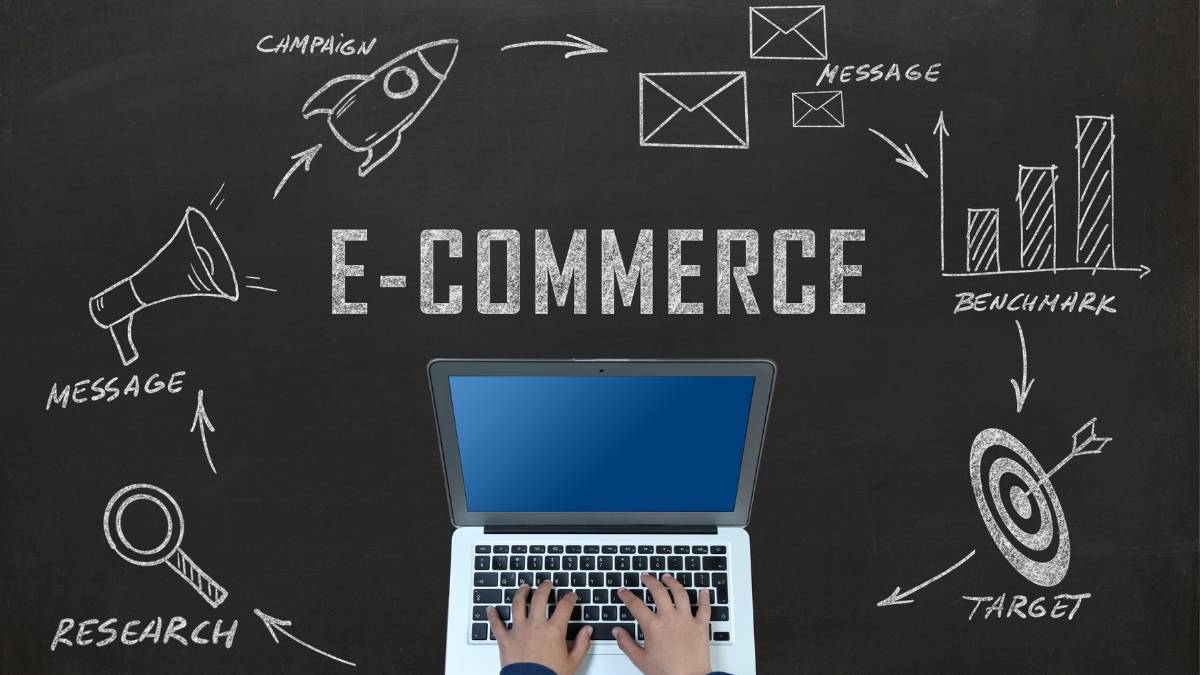
E-commerce marketing isn’t just a fancy term; it’s what makes an online store actually work. This blog looks at how stores attract people, get them to buy, and keep them coming back. It walks through the usual suspects: SEO, Google Ads, social media, but also digs into email flows, SMS updates, influencer collabs, and even loyalty programs. There are tips on optimizing product pages, simplifying checkout, and tracking what really matters, not just clicks. The guide also touches on strategy, metrics, and common questions about costs and skills. It’s meant to be a practical, no-nonsense roadmap for anyone running or building an online store.
Table of Contents
Introduction: What Is E-Commerce Marketing and Why Does It Matters
E-commerce marketing is everything that helps an online store get discovered, convince people to buy, and bring them back again. It’s not just ads or social posts. It’s the full system behind how traffic turns into revenue. In simple terms, e-commerce marketing is how online businesses attract visitors, convert them into customers, and retain them after the first purchase.
The reason e-commerce marketing exists is straightforward: products don’t sell themselves online. Unlike a physical store, there’s no foot traffic, no sales assistant, and no instant trust. Every click has to be earned. Every product needs positioning. And every purchase decision happens with competitors just one tab away.
This is why even great products fail without marketing, and average products win with the right strategy. E-commerce marketing fills the gap between having a store and actually making consistent sales.
This guide is for:
- Beginners trying to understand how online stores actually grow
- Store owners struggling with traffic, conversions, or repeat sales
- Marketers who want a clear, practical view of how e-commerce marketing really works
If you’ve ever wondered why your store gets visits but not sales or why sales stop when ads stop, you’re in the right place.
What Is E-Commerce Marketing? (Clear Definition With Examples)
E-commerce marketing is the process of promoting products sold online using digital channels to drive traffic, convert visitors into buyers, and increase customer lifetime value.
That’s the clean definition. But in practice, it’s more layered than that.
Take a direct-to-consumer (DTC) brand selling skincare. Their e-commerce marketing includes search visibility when someone looks for solutions, social ads that introduce the brand, product pages that build trust, abandoned cart emails that recover lost sales, and post-purchase messages that bring customers back for refills.
Now compare that to a marketplace seller on Amazon or Flipkart. The product may already have demand, but marketing still exists ; in the form of optimized listings, reviews, sponsored placements, pricing strategy, and brand differentiation within a crowded catalog.
Both are e-commerce. Both rely heavily on marketing. The difference is where the control sits.
A common mistake is assuming that selling online automatically equals marketing online. It doesn’t.
Selling online is setting up a store and listing products.
Marketing online is creating demand, visibility, trust, and momentum around those products.
Without marketing:
- Traffic is inconsistent
- Conversion rates stay low
- Repeat purchases don’t happen
E-commerce marketing is what turns a website into a business.
How E-Commerce Marketing Works (Traffic – Conversion – Retention)
At its core, e-commerce marketing follows a simple loop:
Traffic – Conversion – Retention
Most stores focus heavily on the first part and ignore the rest.
Traffic is about visibility. This is where people first discover your products: through search results, ads, social media, content, or marketplaces. The goal here isn’t just volume. It’s relevant traffic. Ten interested visitors outperform a thousand random clicks.
Conversion happens on your site or app. This is where product pages, pricing, images, reviews, shipping clarity, and checkout experience do the heavy lifting. Marketing doesn’t stop once someone lands on your site; it continues through every scroll and click.
Retention is where real profitability lives. Follow-up emails, WhatsApp updates, post-purchase education, reorder reminders, loyalty incentives; all of these are marketing. A store that depends only on first-time buyers is always fragile.
What connects all three stages is consistency:
- Channels bring people in
- Product pages and checkout convert them
- Retention systems bring them back
And this is why e-commerce marketing continues even after the sale. The first purchase is just the start. The real advantage comes from building a system where customers buy again without needing to be re-convinced from scratch every time.
When done right, marketing stops feeling like “promotion” and starts working like infrastructure; quietly supporting growth in the background.
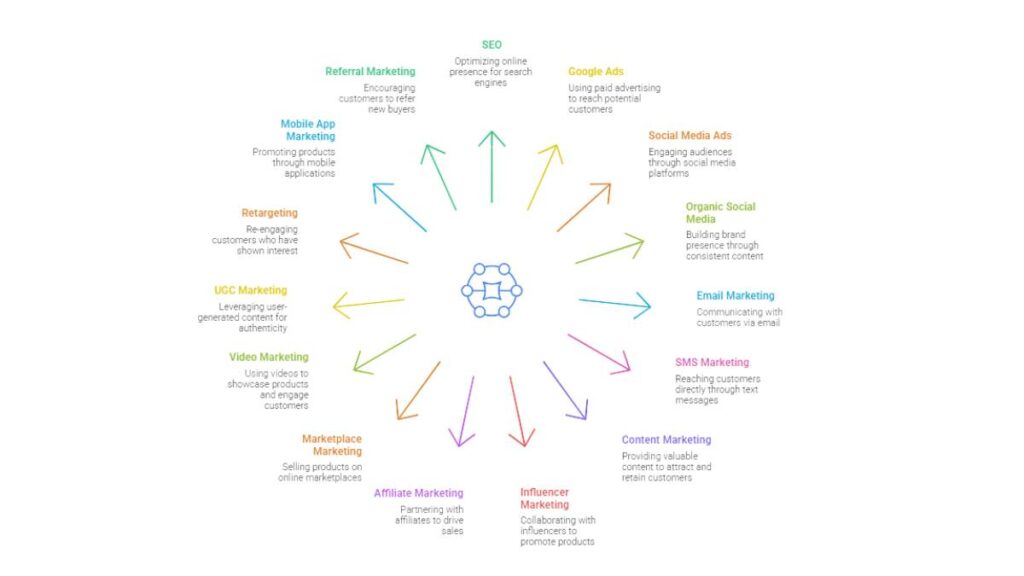
E-Commerce Marketing Channels
E-commerce marketing channels are not tactics you randomly stack together. Each one plays a specific role in how customers discover you, judge you, and decide whether you’re worth their money. Most struggling stores don’t lack channels. They lack clarity.
Some channels capture existing demand. Others create it. Some are loud and front-facing. Others quietly print money in the background. Problems start when everything is treated the same.
1. E-Commerce SEO (Search Engine Optimization)
E-commerce SEO works because buyers often start with questions, comparisons, or very direct purchase intent. The job here is not to chase every keyword, but to match the right pages to the right intent.
Product and category research usually reveals two patterns:
- People who know exactly what they want and are ready to buy
- People who are comparing options and narrowing down
Product pages should speak directly to buyers. Category and guide pages help undecided visitors move closer to a decision. When internal linking is clean and categories actually make sense, the entire store becomes easier to navigate and trust.
2. Google Ads for E-Commerce
Google Ads are about timing. Catching someone at the moment they’re ready to act. Search ads tend to work well for very specific intent, while Shopping ads rely more on pricing, visuals, and credibility.
The mistake many stores make is bidding on everything and hoping volume fixes the math. It doesn’t. Profit comes from understanding which clicks are worth paying for and which ones only look good on reports.
3. Social Media Advertising for E-Commerce
Social media ads don’t wait for demand. They spark it. Facebook and Instagram work best when ads feel native, not pushy. Less “buy now,” more “this might be useful.”
Cold audiences are about curiosity. Retargeting is about reminders. Catalog ads and dynamic formats quietly outperform most flashy campaigns because they feel familiar. People recognize what they already seen. Familiarity converts.

Apply Now: AI-Powered Performance Marketing Course
4. Organic Social Media Marketing
Organic social is slower, but it builds something ads can’t fake: familiarity. People notice brands that show up consistently, even if they’re not buying yet.
Instagram and TikTok lean toward discovery and storytelling. Facebook still works well for communities and updates. Organic content rarely drives instant sales, but it makes every future interaction easier. Ads work better. Emails feel warmer. Brand searches increase.
5. Email Marketing for E-Commerce
Email remains one of the most dependable channels in e-commerce. Not because it’s exciting, but because it works.
Welcome emails set expectations. Abandoned cart emails recover sales that were already half-won. Post-purchase messages reduce buyer’s remorse and encourage the next order. Over time, email becomes the quiet engine behind repeat revenue.
6. SMS & WhatsApp Marketing for E-Commerce
SMS and WhatsApp sit closer to the customer than almost any other channel. That’s both a strength and a risk.
Order updates, delivery alerts, and limited offers perform well because they’re timely. The moment messages feel spammy, trust drops fast. Used carefully, these channels feel personal. Overused, they do damage.
7. Content Marketing for E-Commerce Websites
Content marketing supports decisions. Blogs, guides, and comparisons help customers feel confident before buying.
Good content answers the questions customers hesitate to ask. It explains differences, sets expectations, and reduces returns. When done well, it quietly lifts performance across ads, search, and product pages.
8. Influencer Marketing for E-Commerce
Influencer marketing works when it feels real. Audiences can sense forced promotions immediately.
Creator partnerships are most effective when the product naturally fits into the creator’s world. The goal isn’t instant sales. It’s trust, discovery, and social proof that feels earned, not scripted.
9. Affiliate Marketing for E-Commerce
Affiliate marketing is straightforward. Partners promote products. Sales happen. Commissions are paid.
The challenge is not set up. It’s making sure the product converts well enough for affiliates to care. No one promotes a product that burns their audience.
10. Marketplace Marketing (Amazon, Flipkart, etc.)
Marketplace marketing is a different game. Less brand storytelling. More optimization, reviews, pricing, and placement.
Visibility depends on how well listings are structured and how competitive they are inside the platform. Sponsored listings help, but they work best when the product already looks trustworthy.
11. Video Marketing for E-Commerce
Video shortens the gap between interest and confidence. Seeing a product used removes doubt faster than text ever can.
Short demos, before-and-after clips, and simple use cases work especially well. People don’t want perfection. They want clarity.
12. User-Generated Content (UGC) Marketing
UGC works because it’s imperfect. Real photos. Real words. Real reactions.
Reviews, testimonials, and customer videos often outperform polished creatives because they answer the question buyers actually have: “Did this work for someone like me?”
13. Retargeting & Remarketing
Retargeting is where efficiency lives. Visitors who have already shown interest don’t need convincing from scratch.
Cart abandoners, product viewers, and previous buyers convert faster and cost less. Ignoring them is leaving money behind.
14. Mobile App Marketing for E-Commerce
Apps increase repeat behavior when they reduce friction. Faster checkout. Easier reorders. App-only perks.
Push notifications work best when they feel helpful, not interruptive. Timing matters more than frequency.
15. Referral & Loyalty Marketing
Referral and loyalty programs reward behavior that already exists: repeat buying and word of mouth.
When rewards feel fair and easy to understand, customers participate willingly. Lifetime value grows quietly, without extra acquisition spend.
E-Commerce Marketing Tips (That Actually Hold Up)
Most advice sounds good until it meets reality. The tips below aren’t trendy. They’re practical. And they tend to work even when conditions change.
1. Focus on One Primary Channel Before Scaling
Trying to grow everywhere at once usually leads nowhere. One channel, done properly, teaches more than five half-managed ones. Depth builds confidence. Confidence fuels growth.
2. Optimize Product Pages Before Increasing Ad Spend
Traffic exposes weaknesses. If pages don’t convert, ads only make the problem louder. Clear messaging, strong visuals, and honest details fix more issues than most new campaigns.
3. Use Reviews and Social Proof Everywhere
Trust is fragile online. Reviews reduce hesitation faster than any copy tweak. Product pages, ads, emails; everywhere buyers pause, social proof should already be waiting.
4. Retarget Warm Visitors First
Cold traffic is expensive and unpredictable. Visitors who already browsed products or added to cart are closer to buying. Retargeting respects that reality.
5. Prioritize Email and WhatsApp for Retention
Ads rent attention. Email and WhatsApp build relationships. Retention channels smooth revenue and reduce pressure on acquisition. Over time, they become essential.
6. Track Profit, Not Just ROAS
ROAS can lie. High returns don’t matter if margins disappear through refunds, shipping, or discounts. Real decisions require real numbers.
7. Refresh Ad Creatives Often
Performance drops when creatives feel stale. Small weekly tests beat big monthly overhauls. Fresh angles keep attention alive.
8. Simplify Checkout Ruthlessly
Every extra field creates doubt. Clear pricing, visible policies, and fewer steps make decisions easier. Checkout is not the place to impress. It’s the place to reassure.
9. Match Content to Intent
Not everyone is ready to buy. Educational content builds trust early. Comparison content helps make decisions later. Timing matters more than volume.
10. Build Trust Before Discounts
Discounts close sales, but trust builds brands. When everything is always on sale, value disappears. Stores that earn confidence rely less on price cuts and convert better over time.
Conversion Rate Optimization (CRO) in E-Commerce Marketing
CRO is where a lot of “good-looking” stores quietly fall apart. Traffic shows up. Pages load. And still… sales lag. That gap usually has nothing to do with persuasion and everything to do with friction.
Most visitors don’t need to be convinced. They need to feel sure.
Product pages are the first checkpoint. If the title is vague or overly clever, confusion creeps in. If descriptions dodge real questions, sizing, usage, delivery timelines, returns, doubt takes over. Images do more work than copy ever will. Flat, polished shots help, but context shots sell. People want to picture the product in their lives, not just on a white background.
Trust signals decide more purchases than most people admit. Reviews shouldn’t feel buried. Shipping costs shouldn’t feel like a surprise. Return policies shouldn’t read like legal disclaimers. When shoppers sense hesitation from the brand, they hesitate too.
Checkout is where patience runs out. Extra steps. Forced sign-ups. Unexpected fees. Each one is small on its own. Together, they undo weeks of marketing effort. CRO isn’t about tricks or hacks. It’s about removing reasons to walk away. Quietly. Respectfully.
Customer Retention and Lifecycle Marketing
Retention is where e-commerce either stabilizes or slowly bleeds money. Acquiring customers will always cost something. Relying on first-time buyers forever is what makes businesses brittle.
Lifecycle marketing looks beyond the sale. What happens after checkout matters more than most teams realize. A clear order update. A helpful follow-up. A reminder that the brand didn’t disappear the moment payment cleared. These things add up.
Repeat purchases usually come from familiarity, not pressure. Customers come back when the experience feels easy, and the product does what it promised. Loyalty programs help, but they don’t fix broken fundamentals. If the experience is forgettable, points won’t save it.
Personalization works best when it’s subtle. No one wants to feel tracked. But relevance matters. Timing matters. Messaging someone too often does more harm than good. Saying the right thing, at the right moment, does the opposite.
Retention isn’t exciting. It’s steady. And over time, it’s what makes growth feel less stressful and more predictable.
How to Build an E-Commerce Marketing Strategy (Step-by-Step)
A real marketing strategy doesn’t begin with channels. It begins with honesty. About margins. About demand. About how often people actually need the product.
Once that’s clear, channel decisions become easier. Not every store needs to be everywhere. Some products depend on search intent. Others need discovery and education. Trying to force every channel to work usually leads to shallow results across the board.
Budgets should earn the right to grow. Small tests reveal more than big launches. When something works, it shows up in behavior, not just dashboards. When it doesn’t, doubling down rarely fixes it.
Common mistakes show up again and again:
- Driving traffic before fixing weak product pages
- Expanding channels before stabilizing one
- Celebrating ROAS while ignoring margins
- Treating retention as an afterthought
Good strategies evolve. They respond to customers, not trends. They’re adjusted slowly, based on what people actually do. When marketing decisions stay tied to real buying behavior, growth stops feeling chaotic and starts feeling intentional.
E-Commerce Marketing Tools and Metrics
Tools matter, but not in the way most people think. They don’t create growth. They explain it. Or expose where it’s leaking.
At a basic level, tools help answer simple questions:
Where are customers coming from?
What do they do before buying?
Where do they drop off?
Analytics platforms, ad dashboards, and email reports all tell pieces of the same story. The mistake is looking at them in isolation. Numbers only make sense when they’re connected.
The metrics that actually move decisions tend to be boring, but honest:
Customer acquisition cost (CAC): what it truly costs to get a buyer
Average order value (AOV): how much each order brings in
Customer lifetime value (LTV): how much a customer is worth over time
Conversion rate: how efficiently traffic turns into orders
ROAS gets a lot of attention, but it’s incomplete on its own. A campaign can look profitable and still lose money once margins, refunds, shipping, and repeat purchases are accounted for. Real performance shows up when marketing metrics align with business reality.
Good teams don’t obsess over dashboards. They use them to ask better questions, then adjust accordingly.
Common E-Commerce Marketing Questions
Is e-commerce marketing hard?
It can be mostly because it mixes psychology, numbers, operations, and patience. The concepts aren’t complex, but execution takes time. And consistency.
Is e-commerce marketing a good career?
For those who enjoy problem-solving and constant change, yes. E-commerce doesn’t stand still. That keeps the work relevant, but it also demands ongoing learning.
What skills actually matter?
Understanding customer behavior. Reading data without overreacting. Writing clearly. Thinking in systems instead of isolated tactics. Technical skills help, but judgment matters more.
Many people assume success comes from secret strategies or aggressive tactics. In reality, most wins come from doing fundamentals better than competitors and sticking with them longer.
Conclusion:
E-commerce marketing is not about running ads or posting content in isolation. It’s about building a system that brings the right people in, helps them decide, and gives them a reason to return.
At its core, it connects:
- Visibility through the right channels
- Trust through clear product pages and proof
- Growth through retention and repeat purchases
For beginners, the best starting point is rarely “do everything.” It’s choosing one channel, understanding the audience deeply, fixing conversion gaps, and building from there.
Progress in e-commerce marketing is rarely dramatic. It’s gradual. Small improvements stack. Weak spots get addressed. Confidence grows. When the focus stays on clarity, trust, and long-term value, results tend to follow; even if they don’t arrive all at once.
FAQs: About E-Commerce Marketing
1. What Is E-Commerce Marketing in Simple Terms?
Think of e-commerce marketing as everything a store does to get someone from “just browsing” to “actually buying.” It’s not just ads or social posts; it’s the mix of how people discover your product, how easy it is to trust it, and how simple it is to check out. Selling online is one thing; getting people to notice, care, and click that “buy” button is a whole other challenge.
2. How Is E-Commerce Marketing Different From Digital Marketing?
Digital marketing is the big umbrella, covering apps, services, lead generation, brand campaigns, you name it. E-commerce marketing lives under that umbrella but has a sharper focus: sales. Traffic without conversion doesn’t matter much. Likes and shares are nice, but if they don’t translate into revenue or repeat customers, they’re mostly vanity. E-commerce marketing keeps its eyes on real, tangible outcomes.
3. Which E-Commerce Marketing Channel Works Best for Beginners?
Honestly, it depends on the product and who’s buying it. But here’s a rule that usually holds: pick one channel and stick with it long enough to understand it. Too many businesses jump between Instagram, Google Ads, email, and more, spreading themselves thin and getting mediocre results everywhere. One focused channel, done properly, beats half-hearted attempts on ten.
4. How Much Does E-Commerce Marketing Cost?
That’s a tricky one because it really varies. Some small stores can start on a shoestring budget and grow steadily. Others have to spend upfront just to get noticed. The real focus shouldn’t be the number itself, but knowing your acquisition cost, keeping track of margins, and scaling what actually works. Randomly throwing money at ads rarely pays off.
5. How Long Does E-Commerce Marketing Take to Show Results?
Fast results are possible on certain platforms, sure, but sustainable results take patience. Weeks for some early signs, months for something reliable. Quick spikes are tempting to chase, but steady improvement, better pages, clearer messaging, and retention strategies;is what build a business that lasts.
6. Is E-Commerce Marketing Hard to Learn?
Not exactly. The basics are easy enough to understand. The challenge comes with the application. Customers change their minds, trends shift, and platforms update. The trick is paying attention, testing carefully, and learning from what actually happens rather than guessing.
7. What Skills Are Required for E-Commerce Marketing?
It’s more about judgment than technical ability. Useful skills include:
Figuring out what customers actually want, not just what looks good on a report
Reading numbers without overreacting
Writing clearly and persuasively
Thinking about the whole system, not isolated campaigns
Technical knowledge is handy, but knowing how to make decisions under real-world constraints is far more valuable.
8. Can Small Businesses Do E-Commerce Marketing Successfully?
Absolutely. Sometimes, smaller teams can move faster, experiment more, and adapt without layers of approval. The edge comes from focus: clear positioning, solid fundamentals, and paying attention to customers. Big budgets help, but they’re not a substitute for clarity and consistency.
9. Is SEO or Paid Ads Better for E-Commerce?
Neither is inherently “better.” They’re tools with different purposes. SEO builds long-term visibility. Paid ads give speed and control. Most successful businesses use both at different times. The trick is knowing which one serves the goal at hand rather than trying to treat them as equals all the time.
10. Is E-Commerce Marketing a Good Career in 2026 and Beyond?
Yes, if problem-solving and adapting to constant change appeal to you. The field evolves quickly, but fundamentals, understanding customers, driving results, and improving conversions, stay relevant. Those who focus on behavior and business realities, not just trends or platforms, tend to stay in demand no matter what changes come.